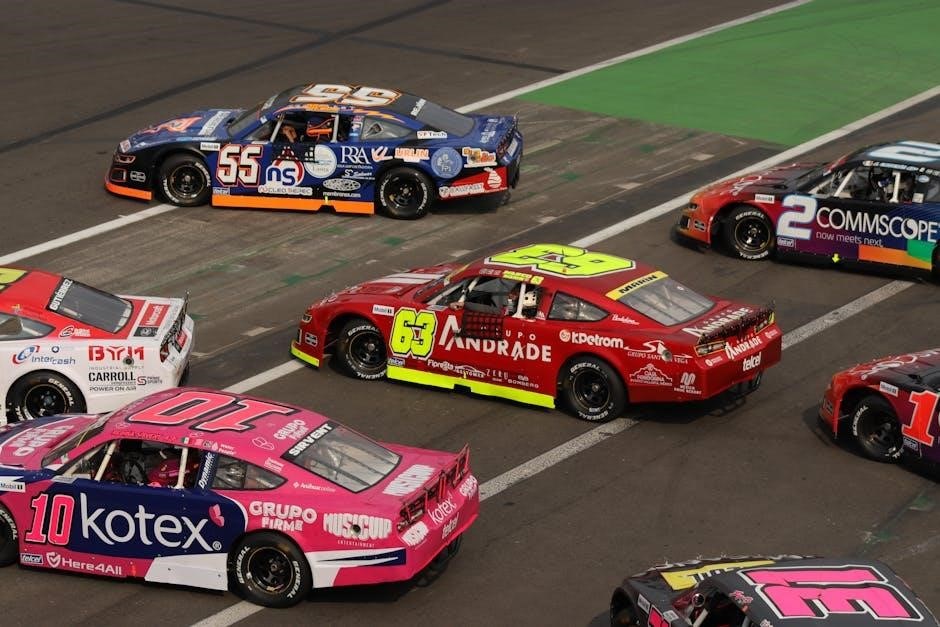
Race car transmissions have evolved significantly, encompassing manual, automatic, and semi-automatic types․ Historically, manual gearboxes dominated, but modern racing increasingly favors paddle-shift systems, showcasing a dynamic shift in technology․
Historical Overview of Transmission Types in Racing
Early racing predominantly featured manual transmissions, specifically H-pattern gearboxes, demanding significant driver skill for precise gear selection and clutch control․ These systems, while requiring expertise, offered a direct mechanical connection and a feeling of control highly valued by drivers․ As racing evolved, the need for faster, more consistent shifts led to the development of dog-ring sequential gearboxes․
These manual systems eliminated the need for full clutch engagement during upshifts, dramatically reducing shift times․ The introduction of automatic transmissions, initially torque converter-based, marked a turning point․ While initially less common due to perceived inefficiencies, advancements in performance torque converter automatics and, crucially, the advent of paddle-shift technology, began to challenge the dominance of manual systems․
Paddle-shift systems, essentially automated manuals, offered the speed of an automatic with much of the control of a manual, paving the way for their widespread adoption in top-tier motorsport․
The Core Question: Automatic vs․ Manual
The debate between automatic and manual transmissions in racing centers on a trade-off between driver involvement, mechanical efficiency, and outright speed․ Traditionally, manual transmissions – particularly dog-ring sequential gearboxes – were favored for their direct control and perceived efficiency, allowing skilled drivers to optimize gear selection for every corner․ However, modern automatic systems, especially those employing paddle-shift technology, have largely closed the gap in performance․
Paddle-shift systems offer incredibly fast and consistent gear changes, often faster than a human can achieve with a manual gearbox․ This consistency reduces drivetrain losses and allows drivers to focus more on steering and braking․ While early automatics suffered from efficiency drawbacks, contemporary designs minimize these issues․
Today, the landscape is shifting; top-tier racing series predominantly utilize paddle-shift systems, demonstrating their competitive advantage, though manual options still exist in certain categories;

Manual Transmissions in Race Cars
Manual transmissions, like dog-ring sequential and H-pattern gearboxes, offer drivers direct mechanical control and a connected driving experience, historically dominating motorsport․
Dog-Ring Sequential Gearboxes: The Standard for Control
Dog-ring sequential gearboxes represent the pinnacle of manual transmission technology in racing․ Unlike traditional synchromesh gearboxes, dog-ring systems utilize straight-cut gears with “dog” teeth that directly engage, enabling incredibly fast and precise shifts․ This design eliminates the need for synchronization, drastically reducing shift time and mechanical losses․
The sequential layout means gears are selected in a predetermined order – typically one-up, one-down – simplifying the shifting process for the driver․ This allows the driver to maintain focus on braking and steering, maximizing performance․ These gearboxes are incredibly robust, capable of withstanding the immense stresses of racing․ They are the preferred choice in many high-level racing series, offering unparalleled control and responsiveness, making them a cornerstone of competitive motorsport․
H-Pattern Manual Gearboxes: A Traditional Approach
H-pattern manual gearboxes represent a more conventional, though increasingly less common, approach to transmission design in racing․ Characterized by the familiar shift pattern resembling the letter “H,” these systems utilize synchromesh gears to smoothly engage each ratio․ While offering a degree of driver involvement and feel, they are inherently slower to shift compared to sequential designs․
Historically prevalent in various racing disciplines, H-pattern gearboxes require the driver to precisely locate each gear, a process that consumes valuable time on track․ Despite this, some series and drivers still favor them for their mechanical simplicity and the unique driving experience they provide․ Dog engagement versions improve shift speed, but still lag behind sequential systems․ They often appear in lower-tier racing or historic motorsport events, representing a link to racing’s past․
Advantages of Manual Transmissions in Racing
Manual transmissions, particularly dog-ring sequential gearboxes, offer distinct advantages in racing, primarily centered around driver control and mechanical efficiency․ The direct mechanical connection between the driver and the drivetrain provides an unparalleled sense of feel and allows for precise gear selection based on track conditions and engine performance․
This direct control translates to optimized engine braking and the ability to ‘heel-and-toe’ downshift, enhancing corner entry speed and stability․ Furthermore, manual systems generally exhibit higher mechanical efficiency than automatics, minimizing power loss through the drivetrain․ While requiring greater driver skill, this efficiency can contribute to faster lap times․ The simplicity of the design can also lead to reduced weight and easier maintenance, though this is becoming less significant with advanced automatic systems․

Disadvantages of Manual Transmissions in Racing
Despite their advantages, manual transmissions present several drawbacks in modern racing environments․ The primary disadvantage is the increased workload and skill requirement placed on the driver․ Precise and rapid gear changes are crucial, demanding significant concentration and physical exertion, potentially leading to errors under pressure․
Compared to automatics, manual systems inherently interrupt power delivery during shifts, however brief, potentially disrupting vehicle momentum․ This interruption, even milliseconds long, can impact acceleration and lap times․ Furthermore, the need for consistent clutch and shifter operation introduces a potential point of failure and adds complexity to the driver’s task․ Modern paddle-shift systems mitigate these issues by offering faster, smoother, and more consistent gear changes, freeing the driver to focus on other aspects of racing․

Automatic Transmissions in Race Cars
Automatic transmissions, particularly performance torque converter automatics and paddle-shift systems, are gaining prominence․ They offer faster shifts and reduced driver workload, enhancing overall race performance․
Performance Torque Converter Automatics: Modern Advancements
Historically viewed as less desirable for outright racing performance, modern torque converter automatics have undergone substantial advancements․ These aren’t your grandfather’s automatics; contemporary designs utilize highly sophisticated hydraulic control systems and robust internal components capable of withstanding the immense stresses of motorsport․
Key improvements include reduced torque losses within the converter itself, allowing for more efficient power delivery․ Multi-disc torque converters and lock-up clutches minimize slippage, maximizing mechanical connection between the engine and drivetrain․ Furthermore, advanced electronic control units (ECUs) precisely manage shift points and torque converter lock-up schedules, optimizing performance for specific track conditions and driver preferences․
These advancements have made performance torque converter automatics a viable, and sometimes preferred, option in certain racing series, offering a blend of durability, drivability, and competitive speed․ They represent a significant departure from the traditional perception of automatics as being slower than manual counterparts․
The Rise of Paddle-Shift Technology
Paddle-shift technology represents a pivotal evolution in race car transmissions, effectively bridging the gap between traditional manual and fully automatic systems․ These systems, while electronically controlled, fundamentally operate a highly refined automated manual gearbox – not a conventional torque converter automatic․ Drivers utilize paddles mounted behind the steering wheel to initiate upshifts and downshifts, with the ECU and hydraulic actuators executing the gear changes with remarkable speed and precision․
The appeal of paddle-shift lies in its ability to deliver incredibly fast shift times, often surpassing the capabilities of even the most skilled drivers using a traditional H-pattern or sequential manual gearbox․ This speed minimizes power interruption during gear changes, leading to improved acceleration and lap times․

Furthermore, paddle-shift systems enhance driver focus by eliminating the need to physically operate a clutch pedal or gear lever, allowing them to concentrate fully on steering and braking․ This technology has become dominant in top-tier racing series, showcasing its performance advantages and ease of use․
Advantages of Automatic Transmissions in Racing
Modern performance torque converter automatics, and particularly paddle-shift systems built upon automated manual principles, offer distinct advantages in racing․ Primarily, they deliver exceptionally fast and consistent gear changes, often quicker than humanly achievable with a manual gearbox․ This minimizes power loss during shifts, translating to improved acceleration and lap times․

The electronic control systems inherent in automatic transmissions allow for precise tuning and optimization of shift points based on various parameters like engine speed, throttle position, and track conditions․ This level of control is difficult to replicate consistently with a manual system․
Furthermore, automatic transmissions reduce driver workload, allowing them to focus on steering, braking, and overall race strategy․ The elimination of clutch operation and gear lever manipulation minimizes fatigue and enhances concentration, particularly during long-distance races․ This contributes to greater consistency and reduced driver error․
Disadvantages of Automatic Transmissions in Racing
Despite advancements, automatic transmissions in racing aren’t without drawbacks․ A primary concern is complexity; these systems are significantly more intricate than traditional manual gearboxes, potentially leading to increased maintenance requirements and a higher risk of mechanical failure․ Diagnostic procedures and repairs can also be more challenging and costly․
Historically, automatics were perceived as less efficient than manuals due to energy loss within the torque converter, though modern designs have mitigated this․ However, some purists argue that automatics can diminish the driver’s direct connection and control over the powertrain, impacting feel and responsiveness․
Furthermore, the reliance on electronic control units (ECUs) introduces potential vulnerabilities․ Software glitches or sensor failures can disrupt shifting performance, potentially leading to loss of drive or unpredictable behavior․ While safeguards are implemented, this remains a consideration in a high-stakes racing environment․
Semi-Automatic Transmissions: Bridging the Gap
Semi-automatic transmissions, like clutchless manual and auto-manual systems, offer a compromise․ They combine the control of a manual with the convenience of automated shifting, enhancing performance․
Clutchless Manual Transmissions: Combining Control and Convenience
Clutchless manual transmissions represent a fascinating intersection of traditional and modern racing technology․ These systems retain the core mechanical structure of a manual gearbox – specifically, the sequential dog-ring design favored for its speed and positive engagement – but eliminate the need for the driver to operate a clutch pedal․ This is typically achieved through hydraulic or pneumatic actuation, allowing for incredibly rapid gear changes without interrupting power delivery․
The benefit is significant: drivers can maintain focus solely on steering and braking, maximizing their control and minimizing shift time․ While not fully automatic, the automated clutch operation provides a level of convenience that reduces driver fatigue, particularly during extended races․ This technology is popular in various motorsport disciplines where driver skill and precise gear selection are paramount, offering a competitive edge without sacrificing the fundamental control of a manual system․
Auto-Manual Transmissions: Automated Shifting
Auto-manual transmissions, often considered a subset of semi-automatic systems, represent a more complete automation of the gear-shifting process․ Unlike clutchless manuals where the driver initiates shifts, auto-manuals utilize sensors and an electronic control unit (ECU) to determine the optimal gear based on factors like engine speed, throttle position, and vehicle speed․ The ECU then commands actuators to execute the gear changes automatically, without any driver intervention beyond selecting a drive mode․
These systems effectively mimic the operation of a traditional automatic transmission but retain the underlying mechanical efficiency of a manual gearbox․ They offer a balance between the convenience of full automation and the performance benefits associated with direct mechanical engagement․ While offering reduced driver workload, some purists argue they may lack the ultimate control offered by a fully manual system, though advancements in shift speed and programming are continually narrowing that gap․

Current Trends in Race Car Transmissions (as of 02/01/2026)
Paddle-shift systems dominate top-tier racing, driven by ECU management for optimized performance․ Future innovations focus on faster shifts and increased efficiency within these automated systems․
Dominance of Paddle-Shift Systems in Top-Tier Racing
As of February 1st, 2026, paddle-shift systems have firmly established themselves as the predominant transmission choice in premier racing series like Formula 1, IndyCar, and top-level sports car racing․ This shift isn’t merely about convenience; it’s a consequence of performance gains achieved through precise and rapid gear changes․ These systems, fundamentally advanced automatic transmissions, allow drivers to maintain focus on steering and braking while the electronics handle gear selection․
The speed and consistency of these shifts, controlled by electronic control units (ECUs), surpass the capabilities of even the most skilled drivers using traditional manual gearboxes․ This translates directly into faster lap times and improved overall race pace․ While manual transmissions, specifically dog-ring sequential gearboxes, still find a niche in some lower-tier categories prioritizing driver skill and engagement, the competitive advantage offered by paddle-shift technology is undeniable at the highest levels of motorsport․
The Role of Electronic Control Units (ECUs) in Transmission Management
Modern race car transmissions, particularly paddle-shift and even advanced manual systems, are heavily reliant on sophisticated Electronic Control Units (ECUs) for optimal performance․ These ECUs don’t just execute gear changes; they actively manage the entire transmission system, analyzing a multitude of data points in real-time․ This includes vehicle speed, engine RPM, throttle position, brake pressure, and even driver input․
The ECU utilizes this information to determine the optimal shift points, controlling the clutch engagement (in paddle-shift systems) and coordinating the gear selection process․ Furthermore, ECUs implement strategies to minimize torque interruption during shifts, maximizing acceleration and efficiency․ Even in sequential manual gearboxes, ECUs can assist with launch control and downshift strategies․ This level of electronic intervention is crucial for extracting the maximum potential from the transmission and maintaining a competitive edge․
Future Innovations in Race Car Transmission Technology
The future of race car transmissions points towards even greater integration of artificial intelligence and advanced materials․ We can anticipate ECUs employing predictive algorithms, learning driver styles to pre-select gears for optimal performance, effectively anticipating needs before they arise․ Research into lightweight, high-strength materials – potentially incorporating carbon fiber or advanced alloys – will further reduce rotational inertia, enabling faster shift speeds․
Furthermore, fully automated gear selection, even in traditionally manual categories, may become more prevalent, blurring the lines between semi-automatic and fully automatic systems․ Exploration of innovative clutch technologies, like electronically controlled multi-plate clutches, could offer smoother and more precise engagement․ Ultimately, the goal is to minimize power loss during shifts and maximize the transfer of engine power to the wheels, pushing the boundaries of speed and efficiency on the track․