
Kodak Pixpro AZ401 Manual: A Comprehensive Guide
Unlock your camera’s full potential! This guide details the Kodak Pixpro AZ401, covering setup, features, and troubleshooting for optimal use.
Welcome to the world of the Kodak Pixpro AZ401! This powerful and versatile digital camera is designed for both beginner and experienced photographers. This manual serves as your comprehensive companion, guiding you through every aspect of utilizing its impressive capabilities. The AZ401 boasts a substantial zoom range, allowing you to capture stunning images from afar, while its user-friendly interface ensures ease of operation.
Whether you’re documenting family memories, exploring creative photography, or simply seeking a reliable camera for everyday use, the Pixpro AZ401 delivers exceptional performance. This guide will help you understand its features, navigate the settings, and ultimately, unlock its full potential to create breathtaking photos and videos. Prepare to embark on a photographic journey!
Unboxing and Initial Setup
Let’s get started! Carefully unpack your Kodak Pixpro AZ401, ensuring all components are present: the camera body, wrist strap, USB cable, and this manual. First, insert a compatible SD card into the designated slot – the camera requires one for storing photos and videos. Next, charge the battery using the provided USB cable and a suitable power adapter.

A full charge typically takes several hours. Once charged, power on the camera using the power button. Follow the on-screen prompts to set the initial language, date, and time. Familiarize yourself with the basic layout and controls. You’re now ready to begin capturing your first images!
Camera Overview: Buttons and Ports
Familiarize yourself with the AZ401’s physical features. The top panel houses the power button, shutter release, and mode dial for selecting shooting modes. On the rear, you’ll find the LCD screen for composing shots and reviewing images. Navigation buttons allow menu access and image playback control.
Essential ports include a Micro-USB port for charging and data transfer to a computer, and an SD card slot for expandable storage. The built-in flash is positioned near the lens. Understanding the location of each button and port will streamline your photography experience and allow for quick adjustments in various shooting scenarios.
Understanding the Mode Dial
The mode dial is central to controlling your AZ401’s shooting experience. Key settings include ‘Auto’ for effortless point-and-shoot photography, ‘Scene’ offering pre-optimized settings for landscapes, portraits, and sports. ‘Program’ allows some manual control while maintaining automatic exposure. Explore ‘Portrait’ for enhanced skin tones and ‘Night’ for low-light conditions.
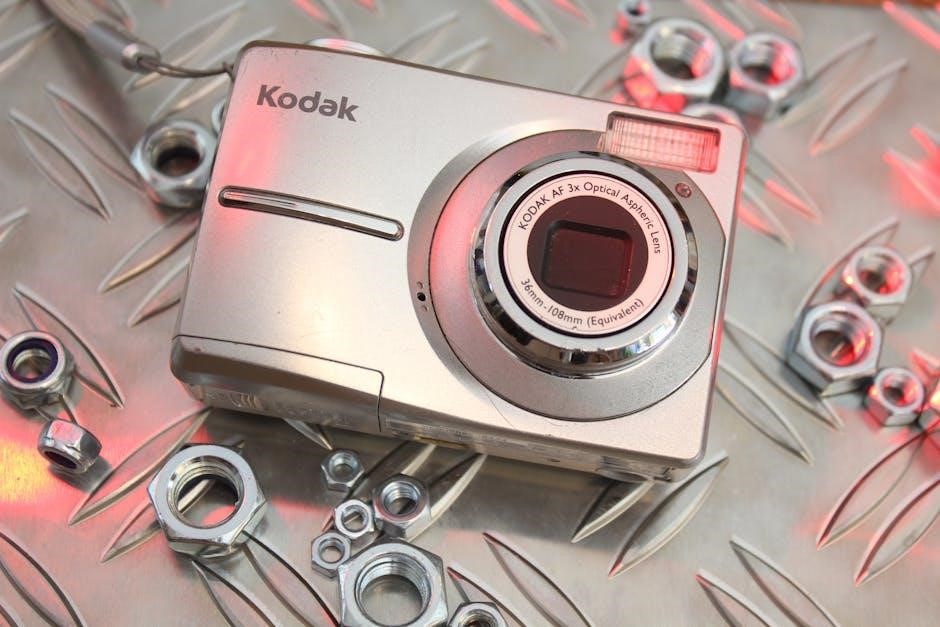
Additionally, you’ll find ‘Video’ for recording movies, and potentially a dedicated ‘Panorama’ mode. Experiment with each setting to understand how it impacts your images; The mode dial provides quick access to frequently used shooting styles, adapting the camera to diverse photographic opportunities.
Navigating the Menu System
The Kodak Pixpro AZ401’s menu system is accessed via the ‘Menu’ button. It’s logically organized into sections like ‘Shooting’, ‘Camera’, ‘Setup’, and ‘Playback’. Use the directional buttons to highlight options and ‘OK’ to select. Within ‘Shooting’, adjust image quality, ISO, and white balance. ‘Camera’ controls date/time, language, and other general settings.
‘Setup’ manages memory card formatting and power options. ‘Playback’ allows reviewing and deleting photos/videos. Familiarize yourself with the menu structure to customize your camera and access advanced features efficiently. Don’t hesitate to explore each option!
Basic Photography with the AZ401
Getting started with the AZ401 is straightforward. Power on the camera and select your desired shooting mode using the mode dial. Frame your shot using the LCD screen, and gently press the shutter button halfway to activate autofocus. Once focused, press the shutter button fully to capture the image.
Experiment with different shooting modes like ‘Auto’, ‘Scene’, or ‘Program’ to achieve varied results. Remember to hold the camera steady to avoid blurry photos. Basic composition rules, like the rule of thirds, can significantly improve your images.
Focusing Modes: Auto and Manual
The Kodak Pixpro AZ401 offers both Auto and Manual focusing options. Auto focus is ideal for everyday shooting, quickly and accurately locking onto your subject. The camera intelligently selects the focus points for you, simplifying the process.
For more control, switch to Manual focus. This allows you to precisely adjust the focus yourself, useful for macro photography or situations where auto focus struggles. Use the directional buttons to fine-tune the focus until your subject appears sharp on the LCD screen. Mastering both modes expands your photographic possibilities.
Using the Zoom Function
The Kodak Pixpro AZ401 boasts a powerful optical zoom, allowing you to get closer to your subject without sacrificing image quality. The zoom is controlled via the zoom lever surrounding the shutter button – push forward to zoom in, and pull back to zoom out.
A digital zoom is also available, extending the zoom range further, but be aware that it utilizes software to enlarge the image, potentially reducing clarity. Utilize the optical zoom whenever possible for the best results. Smoothly adjust the zoom to frame your shot perfectly and capture stunning details.
Advanced Camera Settings
Dive deeper into your AZ401’s capabilities with its advanced settings. Access these through the camera’s menu system, allowing for precise control over image creation. Explore options like adjusting image quality – choosing between different resolutions and compression levels to balance file size and detail.
Master ISO sensitivity to manage the camera’s light sensitivity, crucial for low-light situations. Fine-tune white balance to ensure accurate color reproduction under various lighting conditions. These settings empower you to tailor the camera to your specific shooting needs and artistic vision.
Image Quality Settings (Resolution & Compression)
Control the detail and file size of your photos with the AZ401’s image quality settings. Resolution determines the image’s pixel count – higher resolution means more detail, ideal for large prints or cropping. Compression affects file size; lower compression (higher quality) results in larger files, while higher compression (lower quality) creates smaller files.
Experiment with different combinations to find the best balance for your needs. For web sharing, lower resolution and higher compression are suitable. For professional prints, prioritize maximum resolution and minimal compression to capture every nuance.
ISO Sensitivity Explained
ISO controls your camera’s sensitivity to light. A lower ISO (like 100) is best for bright conditions, producing cleaner images with less noise. As light decreases, increase the ISO (e.g., 400, 800, 1600) to maintain a proper exposure.
However, higher ISO settings introduce more digital noise, appearing as graininess in your photos. The AZ401 allows you to adjust ISO manually or use Auto ISO, letting the camera choose the optimal setting. Understand the trade-off between brightness and image quality when selecting an ISO value.
White Balance Adjustment
White balance ensures accurate color representation in your photos, correcting for different lighting conditions. The Kodak Pixpro AZ401 offers several white balance presets: Auto, Daylight, Cloudy, Fluorescent, and Tungsten. Auto white balance works well in many situations, but sometimes requires manual adjustment.
For example, shooting indoors under fluorescent lights may result in a greenish tint. Selecting the ‘Fluorescent’ preset will correct this. Experiment with different settings to achieve natural-looking colors. Custom white balance allows you to set a precise balance using a white or gray card for ultimate accuracy.
Video Recording Features
The Kodak Pixpro AZ401 excels in capturing memorable videos with ease. Access video mode via the mode dial, and initiate recording with a press of the shutter button. The camera supports multiple video resolutions, including 720p and 1080p Full HD, allowing you to choose the best quality for your needs.
Utilize the optical zoom during video recording for closer shots, but be mindful of potential shakiness. The built-in microphone captures adequate audio, though external microphones aren’t supported. Review recorded videos directly on the LCD screen and transfer them to a computer for editing and sharing.

Recording Video Resolution Options
The Kodak Pixpro AZ401 offers several video resolution choices to balance quality and file size. You can select from 720p (1280×720) for standard definition videos, ideal for quick sharing and conserving storage space. For higher detail and clarity, choose 1080p Full HD (1920×1080), perfect for viewing on larger screens or editing.
Access these options within the camera’s menu system under the video settings. Consider your intended use when selecting a resolution; higher resolutions demand more storage and processing power. Experiment to find the optimal setting for your specific needs and shooting conditions.
Using the Built-in Microphone
The Kodak Pixpro AZ401 features an integrated microphone for capturing audio alongside your videos. While convenient, its quality is basic, suitable for general use and recording ambient sounds. To activate, ensure the microphone isn’t obstructed during recording. The camera automatically adjusts audio levels, but be mindful of wind noise or distant sounds.

For improved audio, consider recording in a quiet environment. The AZ401 doesn’t offer manual audio control or an external microphone input. Therefore, post-production editing software can enhance the sound quality if needed. Prioritize clear audio for a more professional video result.
Connectivity and File Transfer
Transferring photos and videos from your Kodak Pixpro AZ401 is straightforward. The primary method involves a USB connection to your computer. Simply use the provided USB cable, and the camera will appear as a removable drive. You can then drag and drop files directly. Alternatively, the AZ401 supports SD cards for easy transfer.
Remove the SD card and insert it into a card reader connected to your computer. This is often faster than USB. Ensure the SD card is properly formatted before use. The camera doesn’t offer wireless connectivity options like Wi-Fi or Bluetooth for direct transfer.

Connecting to a Computer via USB
To connect your Kodak Pixpro AZ401 to a computer using USB, first ensure the camera is powered off. Locate the USB port on the camera – typically covered by a rubber flap. Connect the mini-USB end of the provided cable to the camera and the standard USB end to your computer.
Power on the camera. Your computer should recognize it as a removable storage device. If prompted, select “Mass Storage Device” mode on the camera’s screen. You can then access the camera’s internal memory or SD card to copy photos and videos. Safely eject the camera from your computer before disconnecting the USB cable.
Using SD Cards for Storage
The Kodak Pixpro AZ401 utilizes SD cards for expanded storage, allowing you to capture more photos and videos. Ensure you’re using a compatible SD card – typically SDHC or SDXC – with sufficient capacity. To insert a card, locate the SD card slot (usually on the side of the camera) and gently insert the card until it clicks into place.
To format the SD card (recommended when new or after transferring files), access the camera’s menu and select the “Format” option. Formatting erases all data, so back up important files first. Always safely eject the SD card from the camera before removing it to prevent data corruption.
Troubleshooting Common Issues
Encountering problems with your Kodak Pixpro AZ401? This section addresses frequent issues. If the camera won’t power on, check the battery charge and ensure it’s correctly installed. For blurry images, verify proper focus and sufficient lighting. If the screen is frozen, try resetting the camera by removing the battery for a few minutes.
Image quality problems might stem from incorrect settings; review resolution and ISO. If files are corrupted, format the SD card. Consult the full manual for detailed solutions and error messages. Remember to regularly check for firmware updates!
Camera Not Turning On
Is your Kodak Pixpro AZ401 failing to power on? First, confirm the battery is fully charged using the provided charger. Ensure the battery is correctly inserted into the compartment, checking for proper alignment. If still unresponsive, try a different, known-good battery if available. A reset might help – remove the battery and SD card, wait several minutes, then reinsert.
Inspect the charging port for any debris or damage. If the issue persists, consult the full user manual for further troubleshooting steps or contact Kodak support for assistance. A faulty power button is a less common possibility.

Image Quality Problems

Experiencing blurry or low-quality images with your Kodak Pixpro AZ401? Begin by verifying the lens is clean, free from smudges or fingerprints. Ensure you’re using the appropriate shooting mode for the conditions – Auto often works well, but explore others. Check the image quality settings; higher resolution and lower compression yield better results.
Insufficient light can cause blur, so consider using a tripod or increasing ISO sensitivity (but be mindful of noise). Confirm proper focus – utilize autofocus or manual focus as needed. Review the SD card for potential corruption.
Battery Management and Charging
Maximize your Kodak Pixpro AZ401’s runtime with these battery tips! The AZ401 utilizes a rechargeable lithium-ion battery. For optimal performance, fully charge the battery before first use. Use only the supplied charger to avoid damage. Charging typically takes several hours, indicated by a charging light.
Avoid extreme temperatures, as they can reduce battery life. When storing the camera for extended periods, charge the battery to around 50% to prevent degradation. To conserve power, disable features like Wi-Fi when not in use and utilize the auto-power-off function.
Cleaning and Maintenance
Keep your Kodak Pixpro AZ401 in pristine condition with proper care! Regularly clean the lens with a soft, microfiber cloth to remove dust and fingerprints. Avoid using harsh chemicals or abrasive cleaners. Gently brush away debris from the camera body using a soft brush.
Protect the camera from extreme temperatures, humidity, and direct sunlight. Store the camera in a dry, dust-free environment when not in use. Periodically check the battery compartment for corrosion. Handle the SD card with care, avoiding exposure to static electricity or magnetic fields.
Understanding the Kodak Pixpro AZ401’s Features
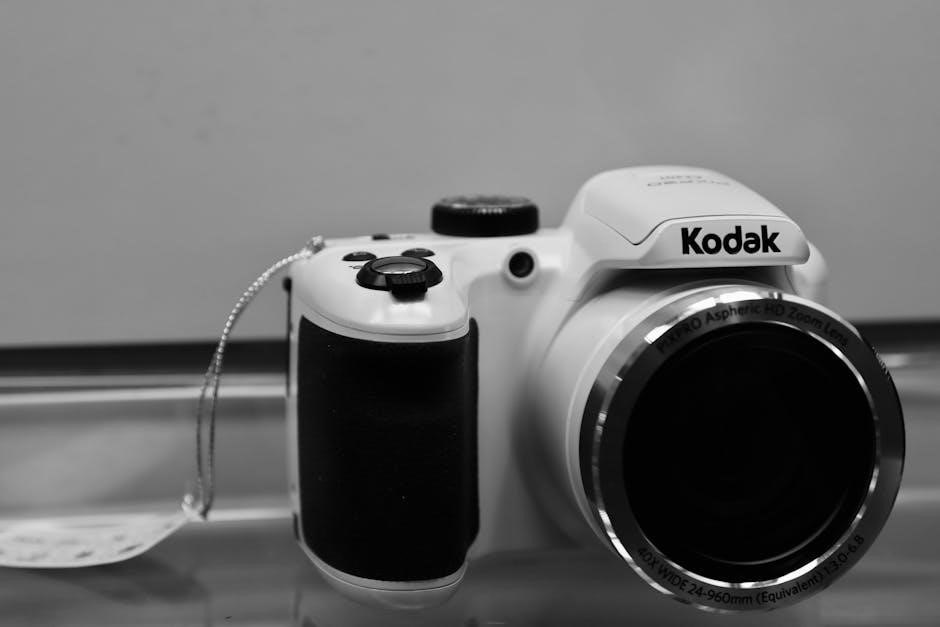
The Kodak Pixpro AZ401 boasts a powerful 20MP sensor and a 40x optical zoom lens, enabling stunning detail and versatility. It features a 3-inch LCD screen for easy viewing and composition. Explore various shooting modes, including Auto, Scene, and Program, to capture perfect images in any situation.
Benefit from built-in image stabilization for sharper photos and videos. The camera supports 720p HD video recording. Its compact and lightweight design makes it ideal for travel and everyday use. Discover its user-friendly interface and unlock creative possibilities!
Frequently Asked Questions (FAQ)
Q: Why won’t my camera turn on? Ensure the battery is fully charged and correctly inserted. Q: How do I transfer photos to my computer? Use the included USB cable or an SD card reader. Q: What SD cards are compatible? The AZ401 supports SDHC cards up to 32GB.
Q: How do I adjust the image quality? Access the menu and select your desired resolution and compression level. Q: Can I use external microphones? No, the AZ401 only supports its built-in microphone. Q: Where can I find the latest firmware updates? Check the Kodak website for available downloads.
Where to Find Additional Support & Resources
For comprehensive assistance, visit the official Kodak Pixpro website. There, you’ll discover a dedicated support section featuring downloadable manuals, frequently asked questions, and troubleshooting guides. Explore online forums and communities dedicated to Kodak cameras; fellow users often share valuable tips and solutions.
Consider searching for online tutorials on platforms like YouTube, offering visual demonstrations of the AZ401’s features. Kodak’s customer support team is also available via email or phone for personalized assistance. Remember to have your camera’s model number ready when contacting support.